Multi-omics technologies are unlocking deeper biological insight – but the real inflection point is not volume. Instead, the field is moving towards integration: in other words, turning multi-layered biology into confident R&D decisions across the full drug development value chain.
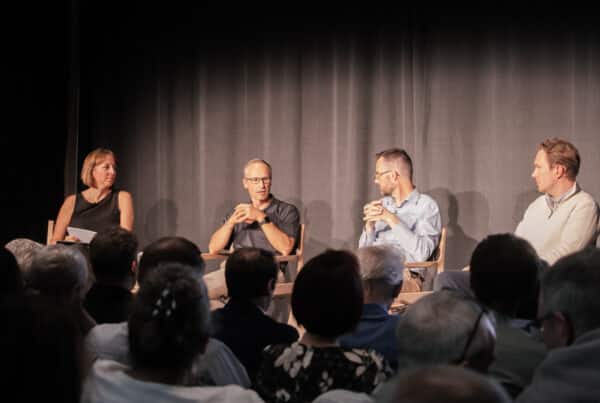
That was the core thread running through the February 2026 edition of DayOne’s Open Mic: Next in Health event series, “Multi-omics intelligence: Platforms accelerating precision drug development”, hosted on the Novartis Campus in collaboration with Switzerland Innovation Park Basel Area.
The discussion was moderated by Dr. Ella Dehghani (Swiss Healthcare Roundtable, EllaVates), with panelists Elodie Pronier (VP Biomedical Discovery, Owkin), Prof. Abdullah Kahraman (FHNW), and Dr. Christiaan Klijn (Global Head of Oncology Data Science, Novartis).
What is "multi-omics"?
Multi-omics refers to the integrated analysis of multiple “omics” data layers – such as genomics, transcriptomics, proteomics, metabolomics (and sometimes epigenomics or microbiomics) – to build a more complete, systems-level view of biology and disease than any single dataset can provide.
The shift: from single-omics outputs to end-to-end platform value
A few years ago, “doing omics” often meant generating a single layer of insight and handing it off downstream. The conversation made clear that pharma has moved on: multi-omics now matters most when it connects to validation and development decisions, not when it produces isolated signals.
”We’re not just thinking about the multi-omics in a vacuum – it’s really connected to a validation effort that makes sense.
Christiaan Klijn
The implication for innovators is straightforward: the value proposition is increasingly platform oriented. The winning solutions reduce uncertainty at a specific decision point (or across several), and they come with a realistic path to operationalization inside a drug development organization.
Where multi-omics creates measurable value today
The panel converged on a pragmatic definition of value: multi-omics earns its keep where it is already close to routine use and improves decisions across the chain.
Three “value zones” surfaced clearly:
Target identification and prioritization, with a validation plan attached
Integrated datasets – including preclinical, patient and real-world sources – help teams move beyond the “crowding problem” in oncology (too many efforts converging on the same small set of targets). But identifying more targets is not the win; the win is identifying targets that can be validated and developed with a credible downstream plan.
Molecule optimization using functional readouts
Modern biologics are increasingly complex, and teams need functional readouts to guide iteration. Omics-derived signals can provide that functional feedback loop, especially when combined with robust experimental workflows.
Clinical development and trial design
Longitudinal, multi-modal data collected in trials (not only bulk RNA sequencing) enables a more granular understanding of patient populations – supporting better trial design, patient stratification, and next-generation product criteria.
Translational realism: the clinic is the constraint (and the forcing function)
A recurring reality check is that multi-omics models can be scientifically impressive and still fail the “clinical feasibility” test. If your biomarker requires a long list of assays, modalities and feature-heavy models, clinicians may simply be unable (or unwilling) to use it in real-world trial design.
”You go to a clinician… and the clinician is like, yes, but that’s not going to be relevant and it’s not how we’re going to design the trial.
Elodie Pronier
This is not anti-innovation – it is the translation bottleneck in plain terms. The path forward discussed on stage was not “less ambition,” but better constraint handling: interpretability, feature reduction that respects clinical logic, and smarter proxies for expensive measurements.
One concrete direction highlighted was predicting richer omics layers from more readily available clinical inputs (for example, extracting spatial or proteomic signals from standard pathology slides). Not “there yet,” but viewed as a strategically important route to speed and adoption.
Validation is the currency – and it looks different at each stage
If there was one word that kept resurfacing, it was validation.
In discovery, “ultimate validation” (a drug succeeding in the clinic) may be a decade away. In trials, validation may require embedding new measurements or endpoints into prospective designs, which introduces friction: incentives, timelines, regulatory comfort, and infrastructure maturity.
In clinical settings, the bar becomes existential: decision support impacts patient outcomes, and the expectation shifts toward rigorous evaluation (including trial-grade validation) rather than retrospective benchmarks.
”In a clinical setting… we have to validate, there’s no other means.
Abdullah Kahraman
For startups, the practical takeaway is to define validation in a staged way: what “good” looks like now, what must be true for adoption, and what prospective evidence is needed to earn expanded scope.
Trust and adoption: the Monday morning test
Even the best model fails if no one uses it. Trust, the panel argued, is not a slogan – it is built through usability, transparency, internal dogfooding, and human-in-the-loop workflows that reveal failure modes early.
”Trust isn’t a philosophy… You want on a Monday morning… to go and use your tools.
Ella Dehghani
One particularly sharp nuance: “explainability” is not the same as forcing AI to mimic human reasoning. If a model outputs a story that sounds reasonable but does not reflect how it produced the prediction, that can create false confidence rather than real trust.
Partnering versus in-housing: what becomes core capability?
The discussion treated partnering as a strategic reality – but also a survival question for innovators: can you maintain differentiation as methods and tooling evolve quickly?
A key point from the pharma side: technical models alone are not enough to differentiate long-term. The stronger partnering case often combines:
- unique data access (or ability to generate new data),
- operational speed and execution capability,
- and a clearly scoped measurable outcome tied to drug development decisions.
From the startup perspective, partnering can also be a rational risk allocation strategy for pharma teams facing a fast-moving methods landscape, where internal reinvention every six months is neither practical nor desirable.
If you are building a multi-omics, data science, or AI-enabled solution that can help pharma R&D make better decisions – from discovery through clinical development – DayOne is here to help you accelerate the path from promise to platform.
Explore DayOne’s startup support (e.g. the DayOne Accelerator), sign up for our newsletter to be informed about our upcoming Open Mic sessions, or get in touch to discuss how we can support your journey from early validation to scaled partnerships.
Please note: This article was based on discussion during the recent Open Mic: Next in Health event held on February 09, 2026, titled “Multi-omics intelligence: Platforms accelerating precision drug development”.