On 7 May 2026, DayOne hosted a “Ask Me Anything” webinar to answer your most pressing questions regarding the DayOne Accelerator program, including what the program entails, which ventures are in scope and how the selection process works.
In case you missed it, please find the top questions and answers below.
Eligibility and Venture Profile
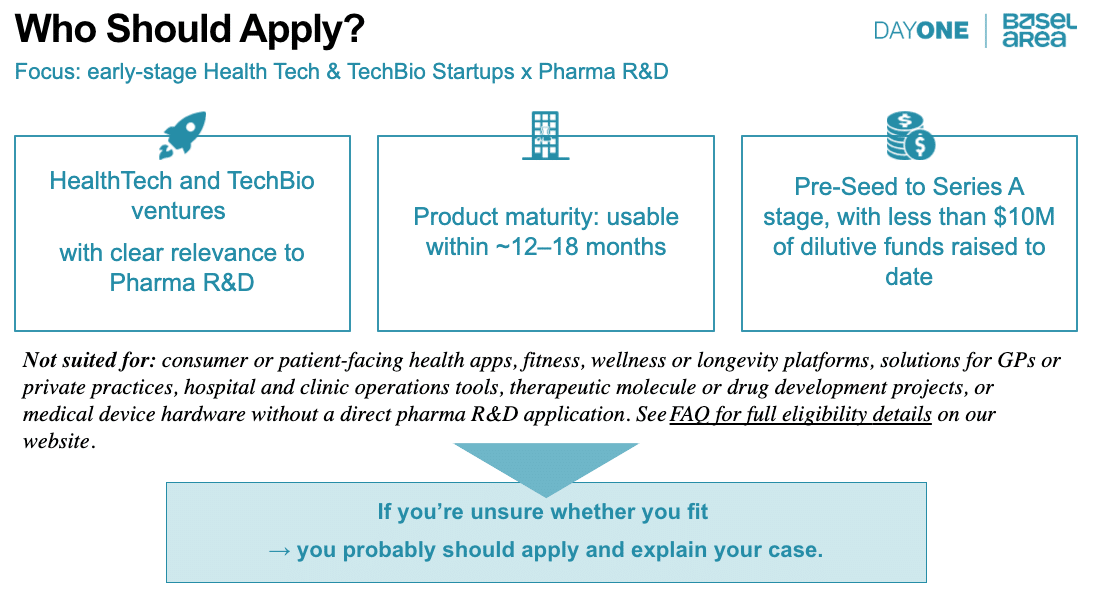
Q1: What types of startups are eligible for the program? How many get selected?
A: The program supports startups developing tech solutions for pharma companies across areas such as software platforms for drug discovery, clinical trials optimization, data collection, digital or imaging biomarkers, remote patient monitoring in decentralized clinical trials, and companion diagnostics for patient identification and stratification. The main criterion is whether the solution addresses a meaningful pharma R&D challenge or fits into pharma R&D workflows and operations.
Companies working on enabling technologies, patient coordination or pharma-facing platforms may be eligible depending on their use case and value proposition in the context of pharma R&D.
Among all applications submitted, 15 startups will get selected to join the 2026 cohort.
Q2: What stage should startups be at to apply?
A: The program is designed primarily for early-stage startups (pre-Seed to pre-Series A). Each year, applicants successfully selected for the cohort are a mix of companies that range from university spin-offs with strong scientific validation to more mature ventures with pilots, partnerships, customers or revenue. Startups already collaborating with pharma companies are often a particularly strong fit, especially if they are looking to refine their strategy, positioning, commercialization approach, or scale beyond initial pilots.
Both incorporated startups and non-incorporated spin-offs are eligible, as long as they have enough operational runway and team bandwidth to actively participate in the program.
Q3: Is there specific focus/theme or are there funding requirements?
A: The program does not focus on specific therapeutic areas and does not require a particular funding background or institutional support. Instead, it looks for startups solving relevant challenges for pharma companies in R&D, across different technologies and domains.
The program is generally best suited for companies that still benefit from mentoring, ecosystem access and early-stage investor exposure, rather than later-stage ventures focused primarily on fundraising or business development.
Program Activities and Participation
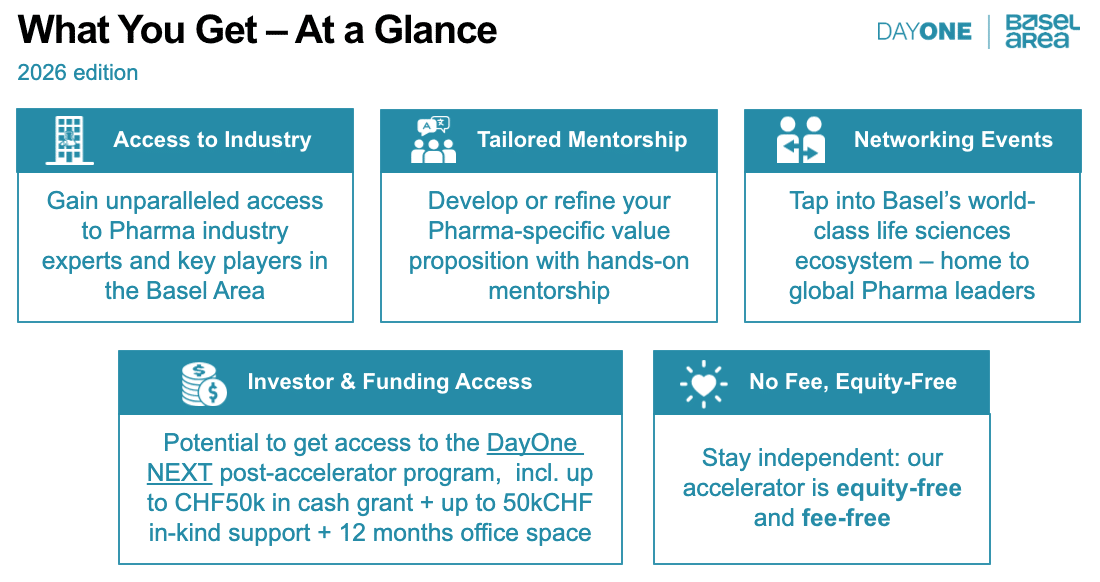
Q4: What activities and topics are included in the program?
A: The program combines three main elements: personalized mentoring, industry insights sessions, and networking opportunities.
The program includes two mandatory in-person events in Basel, Switzerland, to kick off the acceleration (Kickoff Bootcamp on 7-8 September 2026) and close the program (Innovation Showcase in early December 2026).
Each startup gets paired with a dedicated mentor to receive 1:1 support primarily to help them shape or refine their value proposition to pharma companies, and can also cover other topics such as strategy, business model development, product positioning, etc.
The program also includes webinars, founder exchanges and sessions with pharma professionals covering topics such as:
- Value proposition refinement
- Go-to-market strategy
- Procurement processes
- IP and legal considerations
- Regulatory, life sciences compliance and quality management
- Pharma collaboration models
- End-to-end pharma workflows
- Product strategy
- Pitching to pharma executives
Topics above are illustrative only, as the program is specifically tailored each year to match the major needs of each annual cohort.
In addition, startups gain access to multiple networking opportunities and the chance to connect with pharma stakeholders, investors, expand industry networks, and build meaningful relationships within the Basel life sciences ecosystem.
To support startups’ participation in the in-person events (Kickoff Bootcamp and Innovation Showcase) held in Basel during the program period, DayOne provides a travel grant for each team.
Travel grant amount depends on the country or region:
- CHF 300 for Swiss startups based outside of the Basel Area
- CHF 500 for European countries (incl. the UK and Israel)
- CHF 1,000 for more distant locations
Note: the program does not provide direct “warm introductions” or mass contact lists. Instead, startups are expected to actively engage with the network opportunities provided.
Q5: Does the program help startups find pilots with pharma companies?
A: The program helps startups refine their strategy, positioning and understanding of how to work effectively with pharma companies.
The program does not directly arrange pilot projects or perform matchmaking. That said, startups do pitch to pharma executives during the program, which can naturally lead to further discussions if there is strong alignment.
Q6: How intensive is the program, and who should participate?
A: The program includes 1:1 mentoring sessions, expert interactive sessions, kick-off bootcamp, closing innovation showcase and networking opportunities, but the overall intensity depends on how actively each startup engages. Teams that invest time, actively contribute to sessions, and apply the feedback received tend to gain the most value.
The program is designed to work well even for small teams, including startups with only 3–4 people. At least one senior team member should participate consistently throughout the program, while additional team members can join sessions relevant to their expertise, such as sales, product, regulatory or technical topics.
Q7: How does the tailored mentoring work?
A: Each of the 15 startups from the cohort gets matched with a mentor for the duration of the program. Matchmaking is done by the DayOne team and takes into consideration both startups and mentors’ preferences. Mentors and startups are carefully paired based on the startup’s stage, goals and specific needs, with expertise ranging from technical and regulatory topics to medical and commercialization.
Startups typically schedule one mentoring session per week, totalling around 12–15 hours of mentoring throughout the program. The mentoring format and pace are flexible and mutually agreed between the startup and their mentor, ranging from short weekly check-ins to deeper strategy sessions.
Upon discussion with the program manager, if similar needs arise from the cohort, additional cohort expert sessions can also be added during the program.
Q8: Does the program arrange NDAs between mentors and startups?
A: Not directly. DayOne’s contract with mentors includes a confidentiality clause. However, startups may independently establish NDAs with their mentor, pharma companies, investors, experts or partners involved in the program if needed. DayOne signs an NDA with participating ventures during DayOne NEXT, the hands-on post-acceleration phase (open to up to 3 startups following the initial accelerator program). However, because the program involves multiple startups sharing common spaces and activities, startups are encouraged not to disclose highly confidential information during open sessions.
Q9: Is AI used in the selection process?
A: AI may be used internally to support administrative tasks such as summarizing applications or improving review processes, but all applications are pre-screened by a human, then reviewed in-depth by human reviewers and Selection Committee members. Selection decisions are not made by AI.
DayOne NEXT
Q10: How are startups selected for the post-accelerator program, DayOne NEXT?
A: Selection is based on each startup’s performance and engagement throughout the 3-month program, including progress made, responsiveness to feedback, mentor and industry evaluations, and overall growth potential. The program also considers whether establishing a presence in Basel aligns strategically with the company’s stage and goals. To unlock the non-dilutive cash grant (up to 50,000 CHF) and further funding (such as R&D incentives from the Basel-Stadt canton), some R&D activities should be performed in Basel.