As bioconvergence reshapes the life sciences, a growing movement is redefining how we test and develop new therapies by shifting from animal models to human-relevant technologies.
Key takeaways
- Bioconvergence is accelerating innovation at the crossroads of biology, engineering and artificial intelligence.
- Microphysiological systems (MPS) and organoid models promise more accurate, human-relevant data for drug development.
- Automation and AI are key to overcoming challenges of scale, reproducibility and complexity.
- Regulatory recognition is expanding, paving the way for broader adoption of non-animal approaches.
- Collaboration across academia, startups and industry is turning scientific promise into clinical reality.
From animal models to human systems
“Animal models have been a workhorse for the industry for decades,” said Jan Lichtenberg, CEO of InSphero AG. “But they are not human, and we are developing drugs for humans.”
This simple truth is now driving a profound shift in preclinical science. Traditional models often fail to capture the nuances of human biology, metabolism or immune response. As precision medicine and advanced therapies, such as cell and gene therapies, gain ground the need for systems that reflect human biology has become urgent.
Microphysiological systems (MPS), engineered platforms that combine living human cells with microfabricated environments, are offering a solution. These models mimic the function of tissues and organs, allowing scientists to test new drugs under conditions that better reflect the complexity of the human body.
The rise of bioconvergence
At the recent Open Mic: Next in Health session, Gilles Weder, Head of Research & Business Development in Life Science Technologies at CSEM, framed this transformation as part of a broader megatrend: bioconvergence.
“For a long time, science has been divided into disciplines,” he explained. “Today, we see a transversal, multidisciplinary approach integrating biology, engineering and AI to address current healthcare challenges.”
At CSEM, this intersection is where innovation thrives – combining expertise in microengineering, sensor technology and data science to enable the next generation of human-relevant models.
Engineering complexity with purpose
The shift toward MPS is not simply a technical replacement for animal studies; it’s a rethinking of experimental design itself.
Dominic Hoepfner, who leads the Functional Genomics Group at Novartis Biomedical Research, described this evolution:
“It’s not about recreating an entire organ or immune system in a dish. The key is to be as complex as needed, but as simple as possible.”
That pragmatic philosophy is now shaping how researchers define the “context of use” for in vitro models – balancing biological relevance with scalability and practicality.
Meanwhile, Annie Moisan, Discovery Area Leader for Nephrology at Roche, emphasized that new omics data and stem cell technologies are making human-first drug discovery possible:
“We used to rely on animal models to interpret disease. Now, we start with human data – genetics, transcriptomics, proteomics, etc. – and build from there. It’s a paradigm shift.”
Overcoming barriers through automation and AI
Despite the promise of organoids and organ-on-chip technologies, the path to widespread adoption remains challenging. These systems can be costly and complex, with issues around reproducibility, cell sourcing and throughput.
Automation and digital tools are increasingly stepping in to fill that gap. Robotics can standardize workflows, while AI algorithms can analyze vast datasets to identify meaningful biological patterns or predict compatibility between cell types.
As Hoepfner noted, “Robotics and data automation are making it possible to scale in vitro systems in ways animal testing never could. And AI is helping us make sense of the enormous amount of data generated.”
Regulation and recognition on the horizon
As the science advances, regulatory frameworks are beginning to catch up. Agencies in Europe and the U.S. have started to recognize the potential of microphysiological systems as valid tools for safety and efficacy testing.
This shift could have far-reaching implications for the pharmaceutical industry – reducing reliance on animal testing, accelerating timelines and improving translatability from bench to bedside.
A collaborative future for human science
Switzerland has become a fertile ground for this convergence of biology and technology. Organizations like CSEM, alongside startups such as InSphero, and global pharma leaders Roche and Novartis, are creating a collaborative ecosystem that blends academic innovation with industrial scalability.
As Lichtenberg summarized, “When we start with human models from day one, we can make better decisions, faster. It’s the key to more efficient and successful science.”
Looking ahead
The momentum behind human-relevant preclinical models is unmistakable. The combination of bioconvergence, digital transformation and regulatory openness is paving the way for safer, faster and more ethical drug discovery.
This shift is not just about replacing animal testing; it’s about reshaping how we understand and translate human biology.
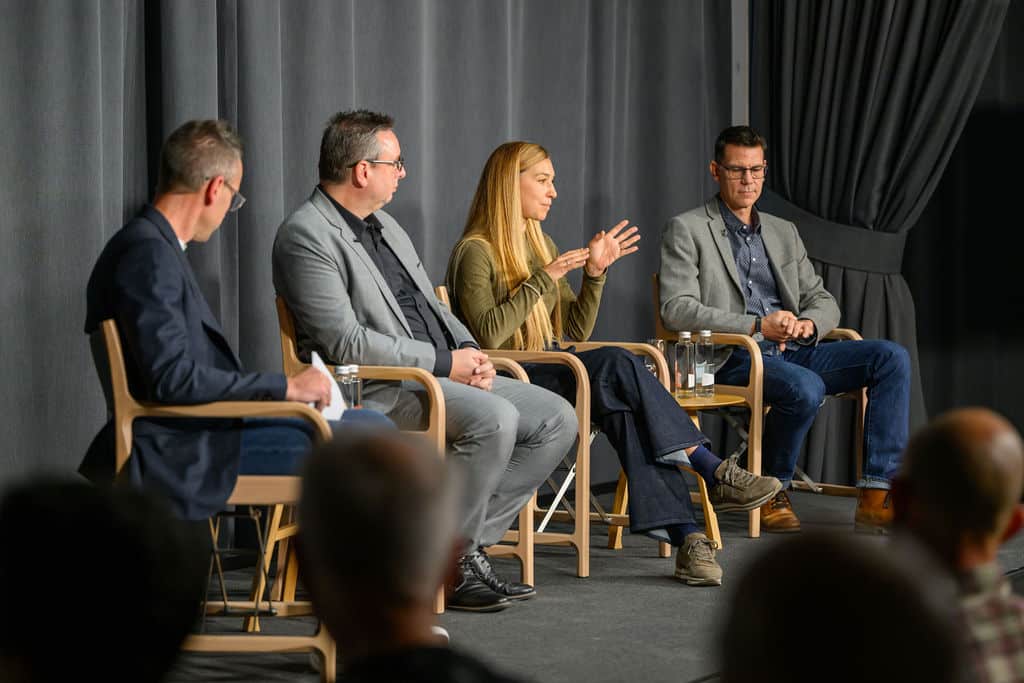
Please note: This article was based on discussion during the recent Open Mic: Next in Health event held on November 10, 2025, titled “Paving the way for human science in preclinical testing”.
To learn more about this event series, register for our next edition and sign up for our newsletter, click here.