Four years of innovation: Celebrating healthcare breakthroughs powered by Innosuisse
What we learned and why co-creation matters in digital health.
Since its launch in 2022, our Innosuisse-powered Digital Health Nation Innovation Booster has supported a range of Swiss startups tackling healthcare’s toughest challenges.
With CHF 910,000 invested and an approach built on open innovation, mentoring and leveraging a collaborative ecosystem, the program helped turn bold concepts into ready-to-implement solutions.
Now, as the Innovation Booster program led by DayOne concludes, we reflect on the journey, the breakthroughs and what lies ahead for digital health in Switzerland.
About the Digital Health Nation Innovation Booster
Swiss Innovation Boosters are open innovation initiatives powered by Innosuisse.
They assemble people from research, business and society at a national level to solve challenges together and stimulate the generation and testing of new innovation ideas.
In 2022, DayOne received a four-year mandate for the Innovation Booster Digital Health Nation with Innosuisse to foster open innovation in Swiss healthcare.
In its initial structure, the program was a three-stage model, selected teams received up to CHF 20,000 in non-dilutive funding, personalized coaching and access to Switzerland’s leading healthcare innovation ecosystem.
In 2025, the Innovation Booster took a more focused approach. We introduced Open Innovation Challenges: concrete, co-developed questions posed by industry and clinical partners.
This model proved especially effective in navigating the complexity of real-world healthcare environments and producing outcomes that stick.
By working closely with hospitals, research institutions and healthcare providers from the start, both challenges were grounded in real clinical needs, tested in live environments and designed for implementation.
1. “Improving clinical data capture for better healthcare outcomes.”
Challenge brought by: University Hospital Basel
We were looking for solutions to simplify and standardize clinical data capturing using openEHR as the standard. The focus was on improving data quality, reducing system fragmentation and supporting better healthcare workflows at the University Hospital Basel. This challenge set out to reimagine how data is captured at the point of care.
2. “AI for code quality and completeness validation under TARDOC and outpatient flat rates.“
Challenge brought by: Kantonsspital Baselland
As Swiss hospitals prepare for the transition to TARDOC 2026, ensuring the accuracy and completeness of clinical coding is critical to avoid revenue loss, reduce manual overhead and maintain regulatory compliance. But expecting busy hospitals to meet those new demands manually isn’t sustainable. This challenge was focused on how AI can validate billing codes before submission.
From initial feasibility to prototyping and go-to-market readiness, the Innovation Booster supported each project with the tools and guidance needed to move fast and build smart.
Project voices
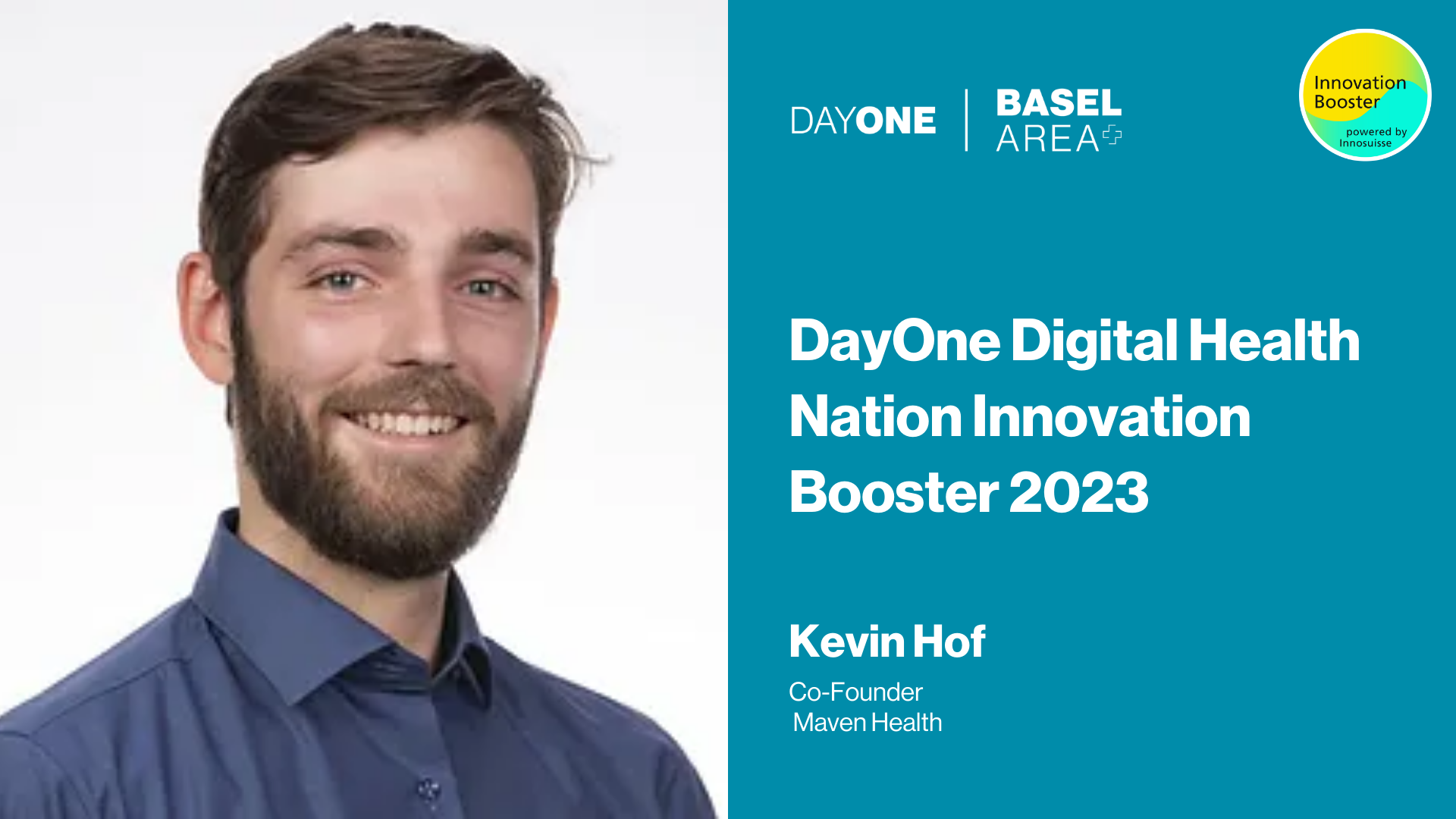
Kevin Hof
Mavenhealth

Maren Schinz
Beyond Diagnostics

Perrine Lhuillier
neurodAIgnostics
Supported by consortium partners
In open innovation, outcomes depend on who’s at the table. The success of the program was made possible thanks to the commitment of a national consortium from across Switzerland.
To everyone who contributed their time, expertise and energy: thank you for helping drive healthcare innovation in Switzerland.






”With the Digital Health Nation Innovation Booster, we are excited to actively shape the future of healthcare in Switzerland and support the growth of innovative start-ups. The program provides entrepreneurs with the opportunity to further develop their digital health solutions and make a significant contribution to a patient-centered digital health ecosystem. We are proud to be part of this initiative to strengthen the Swiss digital health ecosystem and look forward to continuing to drive innovative solutions that will sustainably improve the healthcare sector.
Erik SchkommodauDirector of the Institute for Medical Engineering and Medical Informatics, FHNW
”The Digital Health Nation Innovation Booster initiative is making a real impact, and it’s inspiring to see the wave of innovation it has generated in healthcare. Through our role as a consortium member, we engaged with talented entrepreneurs, helping them transform their ideas into actionable solutions and assess their technical viability. This initiative is playing a valuable role in advancing innovation in the Swiss digital health sector.
Samantha PaolettiHead of Research and Business Development, Life Science Technologies, CSEM
The four healthcare challenge pillars
Working with clinicians, researchers, industry leaders and healthcare institutions in our network, we identified the most pressing system-level bottlenecks. These shaped the four pillars we called startups to tackle.
1. Patient engagement and empowerment
How can we better engage and empower patients in their health journeys?
When patients understand, trust and take part in their care, outcomes improve—and so does system efficiency.
2. Healthcare information quality, access and interoperability
How do we finally make healthcare data more usable and accessible?
For decades, fragmented systems, inconsistent formats and manual processes have hindered progress. By standardizing data, improving documentation and ensuring information flows where and when it’s needed, we break those barriers.
3. Value-based healthcare (VBHC)
How can we better involve patients in managing chronic conditions?
Shifting to value-based care means measuring success not just by treatments given, but by the quality of life patients gain. This pillar called for solutions that personalize treatment and empower patients to take an active role in their health journey.
4. (HCP) education and adoption of digital tools
How do we support healthcare professionals in embracing digital transformation?
Technology can only transform care if those delivering it are empowered to use it. That’s why we want to bridge the digital gap in healthcare.
The startups that rose to the challenge
More than 300 ideas across a wide range of focus areas were submitted, each offering a unique perspective on the future of healthcare.
This diversity of approaches showed just how much innovation potential exists when real needs meet the right ecosystem.
The startups TOM Medications, Resmonics, Leg&Airy, Maven Health, Healtactievy and LEALY have already made the leap from innovation to real-world adoption by successfully launching their products to the market.
An additional five startups are continuing their journey as Innosuisse-funded projects, securing substantial follow-on funding to further validate, develop and scale their solutions:

OncoSwab is advancing early cancer detection with a non-invasive, AI-enhanced point-of-care test for lung cancer. With CHF 1.3 million in Innosuisse funding and clinical trials underway at Inselspital Bern, OncoSwab is pushing lung cancer screening into a new era of accuracy and accessibility.

The solution provides neuropsychologists with robust scores and diagnostic insights within seconds, with no change to the current workflow. The team secured a CHF 0,8 million Innosuisse grant to fund joint product development with USZ and CSEM.

Beyond Diagnostics is developing an AI-powered point-of-care test that verifies insulin quality, turning invisible risks into measurable trust. The team secured CHF 0,65 million to collaborate with CSEM to deepen the research.
Sefit is advancing personalized therapy for neuropsychiatric disorders through a VR-integrated, digital approach. The team secured a CHF 0,45 million Innosuisse grant to fund joint research with the University of Zurich.

dEEGtal secured CHF 0,64 million in Innosuisse Innovation Project funding together with SIP Biel, Swiss HealthTech Center and University Hospital Basel to refine and bring another layer of validation to its AI-powered epilepsy risk prediction in real clinical workflows.
dEEGtal wins DayOne Swiss Innovation Showcase

dEEGtal is redefining how healthcare professionals access and interpret neurological data. By developing a digital biomarker for epilepsy, the team is making early, accurate diagnosis faster and more accessible, especially in time-critical or resource-limited settings. Their AI-powered approach helps clinicians act with greater confidence, backed by structured, scalable data insights.
Their impact was recently recognized at the DayOne Innovation Showcase, where Innovation Booster alumni dEEGtal won the pitch competition hosted at Roche. In autumn 2025, the startup secured Innosuisse project funding, was crowned Microsoft Startup of the Year and is now actively fundraising for their next stage of growth.
”Participating in the Digital Health Nation program led by DayOne gave us much more than funding. It connected us to a rich ecosystem of industry leaders, clinicians, investors and fellow founders. These connections directly led to a collaboration with a leading European hospital, several highly relevant partnership opportunities and a supportive circle of entrepreneurs who have become real companions on the journey. The program also offered us the chance to present at the DayOne Innovation Showcase at Roche, where we won the pitch competition. A truly transformative experience for dEEGtal.
Eric MénétréFounder of dEEGtal
And there are many more to discover! Visit our full portfolio to learn about all the ventures we supported.
Conclusion: Open innovation works for all!
After four years, hundreds of ideas, dozens of startups, one thing is once again proven clearly: real progress in healthcare happens through collaboration.
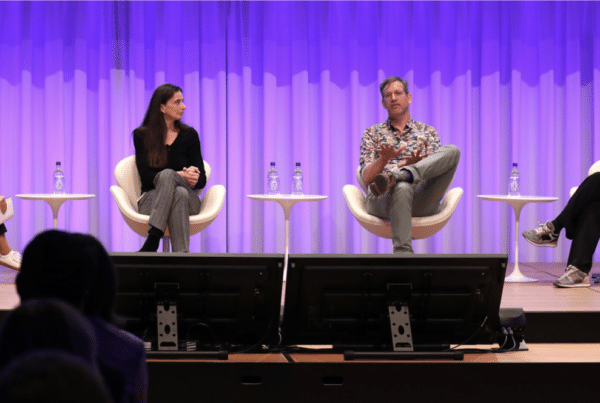
Program numbers show scale, but the stories show impact. At the DayOne Innovation Showcase at Roche, Yana Yoncheva, Program Lead and Manager of Open Innovation at DayOne, shared insights from four years of the Innovation Booster and underlined a simple point: open innovation works when the right people address the right problems together at the right time.
The lessons we’ve learned over the years reinforce this truth:
- Early user engagement cuts risk. Co-creation and early testing replace assumptions with evidence.
- Co-design solves adoption. Adoption is the graveyard of digital innovation. When solutions are co-designed, they fit naturally into the user workflows.
- Innovation is a team sport. Startups bring speed, clinicians bring reality, patients bring truth, corporates bring scale and peer-to-peer exchange brings the spark.
- Respect complexity. Healthcare is uniquely complex – it has more dependencies, constraints and stakeholders than any other sector. Innovation succeeds when it respects this complexity rather than trying to bypass it.
- Innovation fails not because we lack ideas. We don’t need more apps. We needed a way to change how innovation happens.
By uniting startups, clinicians, researchers, patients and industry from day one, we can surface real unmet needs, generate early evidence of viability and produce prototypes shaped by real-world workflows.
The Digital Health Nation Innovation Booster ends, but the innovation engine continues
We’re deeply grateful to every founder, partner, coach and collaborator who contributed their energy, insight and ambition to this program.
What comes next is full of promise.
The ideas sparked here will continue to evolve, the connections made will keep growing and the spirit of open innovation will drive new breakthroughs long after.
If you’re inspired by what you’ve seen, let’s stay connected!
The journey continues and there’s always room for bold thinkers ready to make a difference.
Help fuel the innovation engine!
In 2026, we’ll launch a new Open Innovation Challenge in partnership with University Hospital Basel and Personalized Health Basel.
The focus: co-developing interoperable, openEHR-based digital health solutions that streamline clinical workflows, elevate data quality and improve patient outcomes.
To expand the scope and impact of this effort, DayOne now invites other hospitals and healthcare institutions to join as partners.
—>Partner with DayOne for the next Open Innovation Challenge
Open call for participants and further details about the Challenge will be announced in spring 2026.
Subscribe to our newsletter for early access to upcoming calls, fresh insights and updates on the ventures shaping the future of Swiss healthcare.

Interested in collaboration?
If you would like to learn more about the Challenge outcomes and connect with the supported project teams, we’d be happy to hear from you.
Yana Yoncheva
Manager Open Innovation – DayOne