Dr. Petra Jantzer of Accenture argues that the real value of agentic AI in clinical development will come from connected workflows, not isolated pilots.
Clinical trials are ready for a different kind of digital ambition.
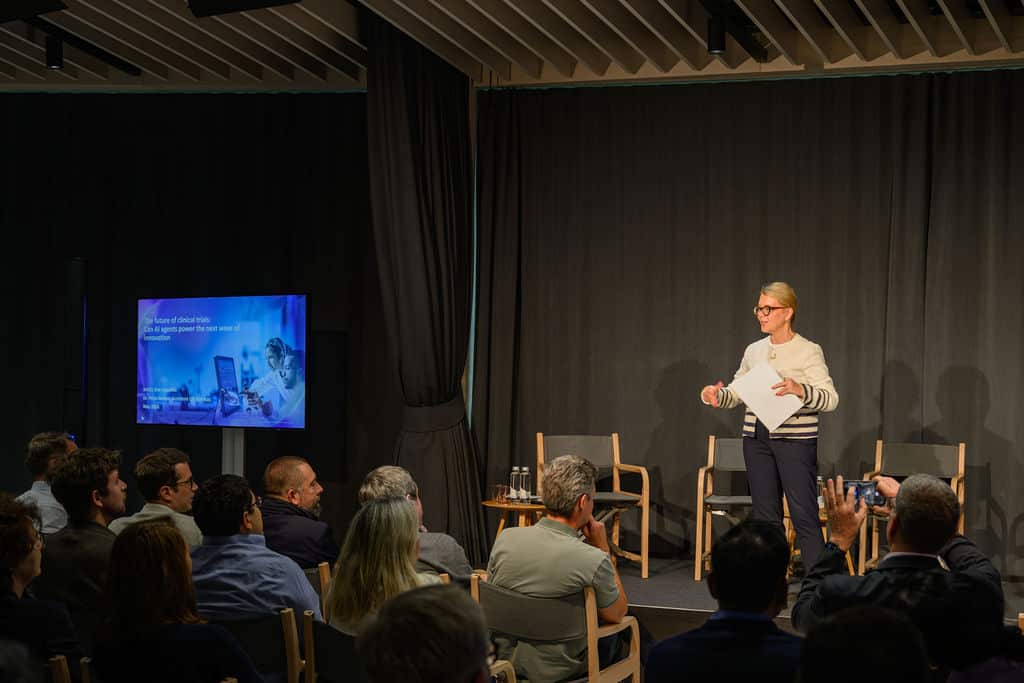
At a recent DayOne Open Mic event in Basel, Dr. Petra Jantzer, Managing Director and Global Client Account Partner at Accenture, explored whether AI agents can power the next wave of innovation in clinical development. Her answer was clear: the opportunity is significant, but only if companies move beyond experiments and rethink how clinical work gets done.
Agentic AI is often discussed as a productivity tool. For clinical trials, that view may be too narrow. According to Petra, the latest AI capabilities could free up 50 to 65 percent of operational capacity in R&D. But the value does not come from saving time for its own sake. It comes from reallocating that capacity toward higher-value work: better scientific decisions, faster development, stronger patient impact and more adaptive trial execution.
”This is not efficiency per se. It is capacity that can be reallocated to higher-value activities, whether that is scientific innovation, faster decisions or patient impact, without adding additional headcount or cost.
The pilot problem
Many organizations are already experimenting with AI. That is not the issue.
The issue is that too many of these experiments sit in isolation. Individual teams launch promising pilots. Technical groups test new tools. Business units look for quick wins. But the initiatives often remain disconnected from each other and from the strategic outcomes that matter most.
Petra described this as the “thousand flowers bloom” stage of AI adoption. It creates activity, but not necessarily impact.
For pharma and healthtech leaders, a pivotal question is “Which part of the value chain should we start to reinvent?”
That shift matters because clinical development is not held back by one single bottleneck. Delays come from handoffs, rework, fragmented data, sequential decision-making and limited visibility across the full development lifecycle. Automating one task can help. Connecting the system can change the performance of the whole process.
Reinvention, not optimization
Petra made a sharp distinction between optimization and reinvention.
Optimization improves the current process. Reinvention asks whether the process would look the same if it were designed today with AI, data and digital orchestration built in from the start.
In clinical R&D, that distinction is critical. Industry pressure is rising through patent expirations, productivity challenges and more complex trials. Incremental improvements alone are unlikely to close the gap.
”If we were designing an R&D organization today and took AI as a given, we would not design the same organizations we see today.
For Petra, the answer sits across three dimensions: work, workforce and workbench.
Work means moving from siloed tasks to end-to-end intelligent workflows. Workforce means preparing teams to work with AI agents, not just digital tools. Workbench means building the secure, interoperable digital backbone that allows people, agents, systems and data to operate together.
Without all three, companies risk applying advanced technology to broken workflows. The result may be a faster version of the same problem.
From sequential trials to adaptive workflows
One of the clearest examples is the journey from IND to first in-human dose.
Today, this phase is heavily coordination driven. Feasibility, protocol design, site selection, vendor setup, contracting and activation often happen sequentially. Each handoff creates room for delay, rework and misalignment.
AI orchestration could change that pattern. Instead of waiting for one step to finish before the next begins, clinical teams could move toward parallel execution, continuous evidence feedback, adaptive protocol refinement and real-time visibility.
The benefit is not only speed. It is adaptability.
If a site drops out, patient recruitment slows, or a regulatory requirement changes, an AI-orchestrated workflow could support faster replanning and better decision-making. The system becomes less brittle because it is continuously learning and adjusting.
”What you gain is not just speed. You gain adaptability. A site drops, a regulatory change comes, and the workflow can adjust in real time instead of triggering long replanning cycles.
What “study in a day” could make possible
Petra also shared a concrete example of reinvention through AI: the idea of designing a study in one day.
The concept brings together complementary AI capabilities. One solution supports evidence-based protocol generation. Another adds simulation, using computational models to test scenarios before a protocol is finalized.
Together, these capabilities could create a closed protocol optimization loop: design, simulate, refine, generate, monitor against actuals and amend only when the evidence demands it.
The potential gains are tangible. Petra pointed to examples including faster protocol development, faster implementation in systems such as EDC and eTMF, fewer amendments and scenario analyses that can be run in minutes rather than days.
For clinical teams, this is more than a productivity story. Better upfront design can reduce downstream friction. Simulation can expose risks before patients are enrolled. Connected workflows can help teams make decisions with stronger evidence and less guesswork.
Adoption is the real test
The hard part regarding AI adoption is not just the technology.
Petra emphasized that agentic AI requires clear business alignment from the start. Business teams need to define the outcomes and decision boundaries. Technology teams need to build for real workflows, not abstract capability. Governance must clarify accountability, oversight and trust when agents support or take decisions.
Architecture also matters. Multi-agent orchestration and enterprise system integration are complex. They need to be designed deliberately, especially in regulated environments where data quality, traceability and human oversight are essential.
And then comes the practical test: will people use it?
”A great idea stays a great idea if users do not adopt it. If users do not understand the benefit, if they are not trained, and if they are not accompanied through the journey, you may have a beautiful solution, but it will not be used.
For pharma and healthtech innovators, that may be the most important takeaway. Agentic AI will not transform clinical trials because the technology is impressive. It will transform clinical trials when it is connected to the right workflows, trusted by the right users and measured against the right outcomes.
The next wave of clinical innovation will not be powered by pilots alone. It will come from clinical systems that learn, adapt and improve with every decision.
Find about our upcoming Open Mics and other DayOne events by signing up to our newsletter here.
About the expert
Dr. Petra Jantzer is Senior Managing Director and Global Client Account Partner at Accenture, where she advises CEOs and senior leaders across life sciences, medical technology and digital health. With more than 20 years of experience in consulting and life sciences, she focuses on digital transformation, growth strategy and innovation across the full life sciences value chain.
Petra holds a Ph.D. in immunology and an honors degree in molecular biology. She is also President and Co-Founder of Advance, a cross-industry association in Switzerland focused on advancing gender equality in business, and represents Switzerland in the G20 EMPOWER initiative.